
Edgar Winter and His Band White Trash
June 6, 1971
The ad below appeared in the Strib on June 4, 1971. Wine and beer night had been extended to Thursdays, Nostalgia and Amateur Nights had been added, and cover charges were gone on Friday and Saturday nights. (The big concerts were on Sunday nights.) 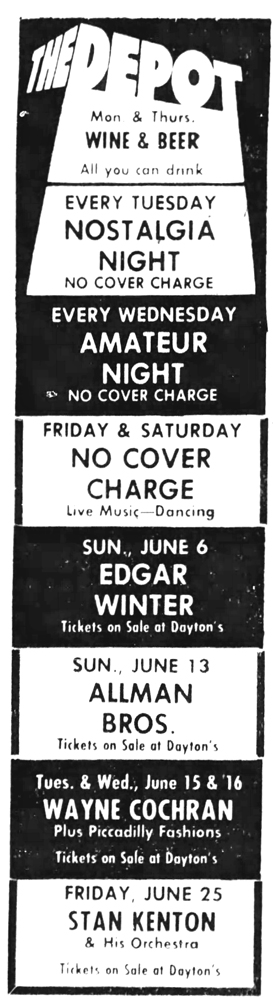
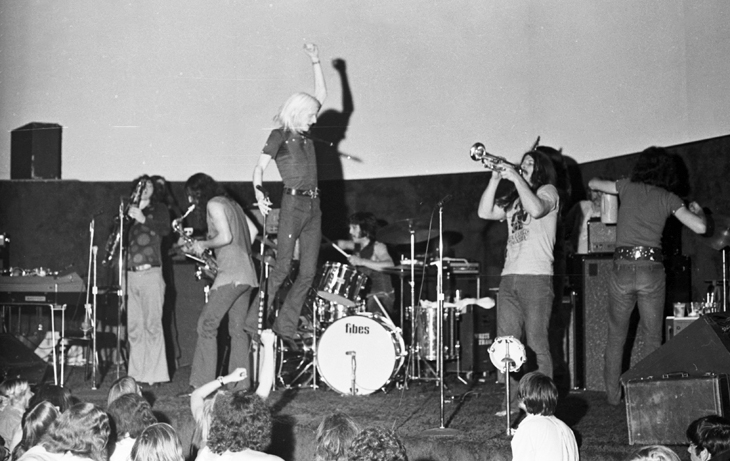
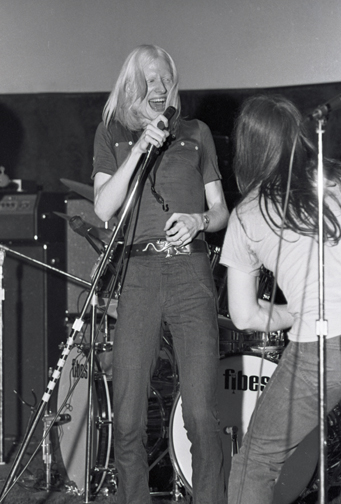
Reviewer Marshall Fine enjoyed Johnny Winter’s brother, saying he was every bit as good, if not better, than his older, more famous sibling. “They have the precision of BS&T, the toe-tapping rhythms of Chicago, the harmonies of Three Dog Night, plus one other distinguishing ingredient: guts.” The set’s showpiece was a long version of “Tobacco Road.” With Edgar’s “wildly soaring voice, the song lost its oldness, as he gave it new dimensions and feelings.” Fine would have preferred that Winter do more of the singing, but that was left mostly up to Jerry la Croix, who Fine accused of looking, sounding, over-emotionalizing, and hamming shamelessly like David Clayton-Thomas. The first part was not necessarily his fault. Robert M reported that this show (no Rick Derringer or Johnny Winter) “was really, really poorly attended – like 25 [450] people at most. They were asked to stay for second set which was exactly same as first. No opening act.” FINANCIAL CRISIS In Will Jones’s column of June 10, 1971, it was revealed that the low attendance at the Edgar Winter show threw the club into a financial panic. Said Allan:
We didn’t take in more than two-thirds of what we needed to pay the group. We were emptying out our safe, and even going into the cash registers to get change that we would need to open up on Monday, in order to pay them. Then something happened that you’re probably not prepared to believe. You know about rock groups and their reputations, and their wanting all the money before they go on and all that. Edgar Winter’s manager came to me and said he knew the club was in trouble, and he gave us back some of the money. He said he liked the club.. He gave us enough so that we could open up Monday. If you know this business, and the kind of people who usually run the rock bands, you know how unusual that is.
Jones reported that Allan had put the last of his personal fortune into the club and told his staff of about 50 people that he couldn’t meet the payroll. Jones thought that was a charitable move, since Allan had warned them in advance instead of stiffing them. Then the staff voted to work for free for a week in an attempt to keep the club open. At that point they were all hoping that the upcoming shows would come off. (Minneapolis Tribune, June 10, 1971) On June 11, 1971, Allan, identified as the “majority owner of the business,” announced that Monday, June 14, 1971, would be the last night at the Depot. “The rock and pop music house will close its doors, and operations will be suspended indefinitely for financial reasons.” He said that the Friday before there were only 150 customers. He was stuck with $35,000 in bills and was contemplating bankruptcy. But he still had hopes of reopening the big hall as a concert venue. (Minneapolis Star, June 12, 1971)