
Stage Coach Inn
Highway 101
Shakopee
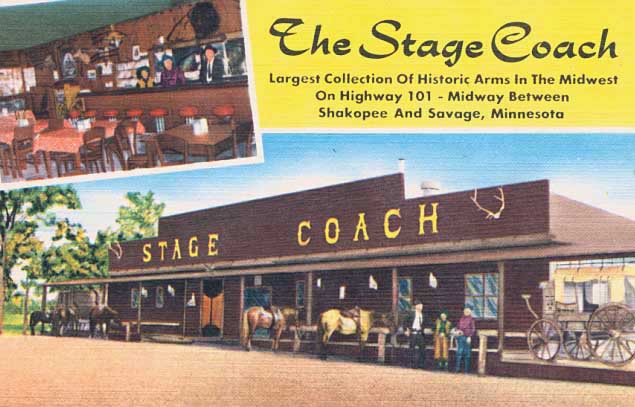
THE STAGE COACH INN
Osborne “Ozzie”Klavestad was an inveterate gun collector since childhood, and by 1950 his collection had outgrown his four-room house in North Minneapolis. It was time to find a place where he could display his collection in a public setting.
The stories about how Ozzie and his wife Marie found the location for the Stage Coach gun museum and restaurant are amorphous.
One is that they found the building by accident, according to a 1964 book on gun collecting. Ozzie had taken Marie out one evening for a drive and they found themselves “lost in a howling rainstorm.” They found themselves in an “a lonely, almost deserted, down-at-the-heels roadhouse.” The place had been the Galenbeck Stage Station, ADA “Four Mill House,” a stopping place where travelers from the Red and Yellow stagecoach lines ate and rested after crossing the Minnesota River aboard the Bloomington Ferry, going to and coming from Fort Snelling between Shakopee and Savage. The Klavestads bought it for a place to display Ozzie’s gun collection, and over the years it expanded to include the Stage Coach Restaurant. (“How the West was Lost,” October 9, 1996, Joseph Hart)
But an entirely different story was reported in 1976, which said that two barracks from a wartime Japanese internment camp had been moved to the location, put together, and turned into “The 101 Club.” Was that was the building that was purchased in 1951 by Ozzie to house his gun collection? (Minneapolis Tribune, August 15, 1976)
Another version just said that the original building of the Stage Coach was part of a former Japanese internment camp that had been located in Savage. The building was made of logs and converted to its present site by the Klavestads. (Sun, Valley Vignette by Lois Geis, September 23, 1970)




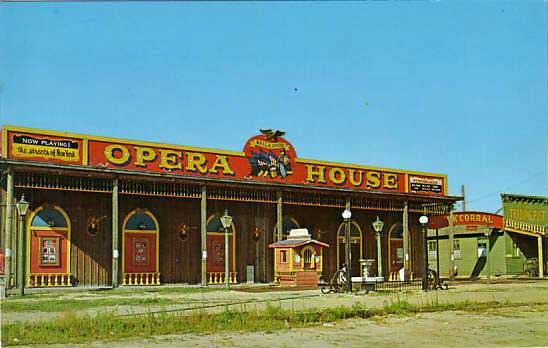
STAGE COACH OPERA HOUSE
The Opera House idea started as the Gamboling House. A stage was built in one part of the room adjacent to the restaurant, and westerns plays were presented. Up to 300 people were squeezed in for performances, which gave Ozzie and Marie the idea for the Opera House. In 1962, the Klavestads bought an old city Machine garage in Minneapolis and moved it west of the gun museum to become the Stage Coach Opera House (AKA the Gamboling House, Valley Union, Bella Union Opera House). 250 seats were donated by the Mann Theaters Co., and Marie covered them with “fancy material.” During the summers, vacationing students faculty members of college drama departments staged plays – mostly melodramas – in the theater. (Minneapolis Tribune, August 15, 1976) (Sun, Valley Vignette by Lois Geis, September 23, 1970)
They billed themselves as the Gaslight Players. This tradition continued until January 25, 1983, when a three-alarm fire burned down the building, which was unoccupied during the winter months. The last advertised shows were in December 1981.
SAND BURR GULCH
In summer 1969, the Klavestads opened Sand Burr Gulch, located at the rear of the Stage Coach complex. This was a recreated Wild West street made out of salvaged artifacts from nearby towns, buildings (like the Metropolitan Building) and dumps. (Minneapolis Star, July 18, 1969)

The town was populated with 75 coin-operated, three-dimensional animated figures in 18 old west buildings. A sound track accompanied roulette and poker games in the Bull Shed Saloon and a shooting on the back balcony on Sundays. Others of the 23 figures in the Bull Shed are Singing Sam the gorilla Banana Man, and a demonstration of sawing a woman in half. Other rooms include the Tonsorial Parlor, an orchestra hall, a dental office, nickelodeons, and a Wax Museum.
The masterminds behind these figures were Leonard Bjerke, Stage Coach maintenance man; Gordon Julius, amusement park designer and contract carpenter; and Don Raverty, St. Paul figuremaker. (Minneapolis Tribune, August 15, 1976)

THE END OF THE STAGE COACH
The Stage Coach property closed at the end of 1979.
An ad appeared on November 7, 1979, soliciting someone to lease the 17,000 sq. ft. property.
In 1981, the Klavestads sold the museum and the five acres of land it stood on to Cal Holzler, owner of the Savage-based Valley Oil Co. for $285,000. Holzler had promised to keep it going, but it turned into ruin instead. An article written in October 1996 describes Sand Burr Gulch as a sad shell of crumbling buildings, covered in graffiti. By 1981 the gun collection was operating as the Stagecoach Gun Shop and San Burr Gulch was a deteriorated ghost town.
The gun collection was eventually sold off, and much of the Stagecoach site was razed in 1996 for the widening of Highway 101.
DAHLEN SIGN
The original Stage Coach building still stands as Dahlen Sign, 901 Stagecoach Road, Shakopee. Dahlen bought the building in 2001 or 2002.


Above and below: September 2025
