
Dirty Flo’s
20-24 Hennepin Ave.
Minneapolis
20-24 Hennepin Ave. was at the eastern end of Hennepin Ave., at the beginning of Skid Row. This page covers the following establishments, although some of them may have just been Skid Row bars:
- Marshall Terrace Cafe
- Glass Door Lounge
- Dirty Flo’s
- 24 Bar
THE BUILDING
The building goes back to 1914 -it replaced a previous building that the Gluek Brewing Co. bought in 1905 and operated as the Bridge Square Hotel on the top two floors with a company-run saloon and pool hall on the first floor. An adjacent building to the east at 18-20 Hennepin Ave. was part of the same hotel operation.
At the end of 1913, Gluek demolished their old building and in 1914 built a replacement on the same footprint, known as the Glueck Brewing Co. Hotel and Saloon. The bar was a “tied house,” where the brewery supported the saloon by supplying beer in exchange for a near exclusive sale of Glueck beer. The tied house practice ended with Prohibition and did not return with repeal.
The building was designed by Minneapolis architect Christopher Adam Boehme. At the time it was in a prime location, being next door to the railroad station and to many hotels and movie theaters.
In 1915, the building was listed in the city directory as a restaurant with furnished rooms operated by James E. Raftery. The following year, the building was listed as the Seymour Hotel, with Joseph P. Seymour as hotel manager for the Gluek Brewing Company. In 1917, the Seymour Hotel was managed by E. J. Seymour and listed at 18-24 Hennepin Avenue, still using the building to the east as part of the complex.
In 1926, the building at became the Clair Hotel with a bar and restaurant on the first floor.
In 1975, the two businesses on the first floor were The Twenty-Four On the Avenue Tavern and the Twenty-Four Restaurant.
It was a three-story building, and it held several businesses, including:
- A Northrup-King outlet
- A furniture store
- Tailor Shop
- Barber Shop
- Saloon
MARSHALL TERRACE CAFE
Within a year after Prohibition ended, the place obtained a beer license and became the elegant-sounding Marshall Terrace Cafe. It was both a cafe and a bar until 1964. Unfortunately for one farmer from St. Peter, it was also a clip joint, where friendly games of poker played with matches ended up with on the cuff real money. The farmer got a free ride back home, where he was obliged to fork over $400 to his new friends. (Minneapolis Journal, May 13, 1934)
The Gluek Brewing Company held ownership until 1959 when it deeded the property to several members of the Gluek family.
GLASS DOOR LOUNGE
Evidence of this establishment was found from 1964 to 1965, in classified ads wishing to rent the place. One mentioned that it was in a construction area, but all said it was fully furnished and established. Although those ads dropped off, there was a very small report of some unfortunate man who was “slugged and robbed” of $2 as he left the Glass Door at 1 am. (Minneapolis Star, April 27, 1970)
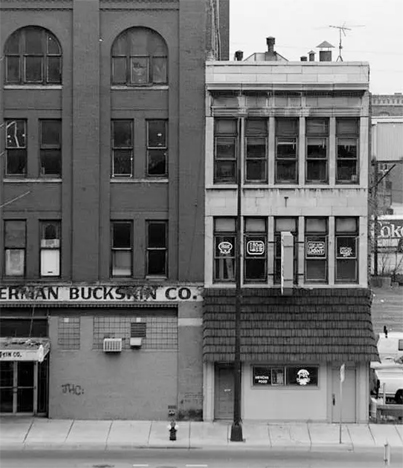
DIRTY FLO’S
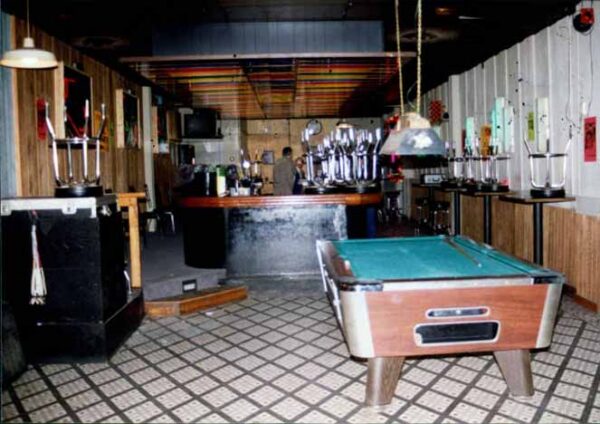
Dirty Flo’s appeared to have been a Country venue. Classified ads promised live music on the weekends by Ken Karey Entertainment. Pat Lindquist, entertainment columnist of the Skyway News, fills us in with the details. The club was owned by Flo Halseth and her son Steve, who bought the old Glass Door in 1969, but the transformation into Dirty Flo’s was not complete until December 17, 1971. The name came from a place Flo had been to in Milwaukee, run by a “tough old madame named Dirty Helen.”
Flo had been in the (hair) salon business, and Steve learned the restaurant business from working at Culbertson’s. In fact, Steve brought Culbertson’s chef along with him for the enterprise.
Pat:
One last tidbit: there’s live foot stompin’ music Thursday through Saturday. For you lazy leggers, just jump on a Nicollet Mall mini and you’ll find it stops right at Berman Buckskin’s corner.
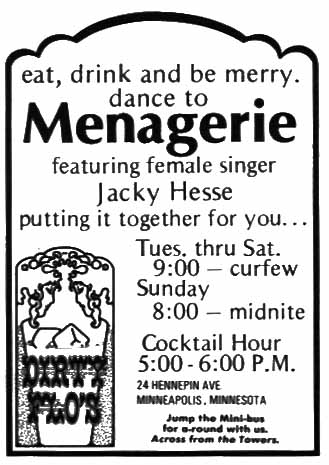
Members of the Bennett Goldberg family owned the building since 1973. In 1975, the two businesses on the first floor were The Twenty-Four On the Avenue Tavern and the Twenty-Four Restaurant.
24 BAR
A loyal Facebook correspondent (before I was unceremoniously kicked off of Facebook) wrote in with this information:
I’m a long-time local music fan and I would like to suggest one addition to your site. Back in the 1980s I used to occasionally frequent the 24 Bar with my buddy Bobby Meide, the drummer for the Flamin’ Oh’s. They had Tuesday night jams, and many local musicians would stop by and hang out.
FEDERAL RESERVE BANK
Plans called for the demolition of the building in 1994 for the construction of the Federal Reserve Bank.
From the Federal Reserve Bank’s website:
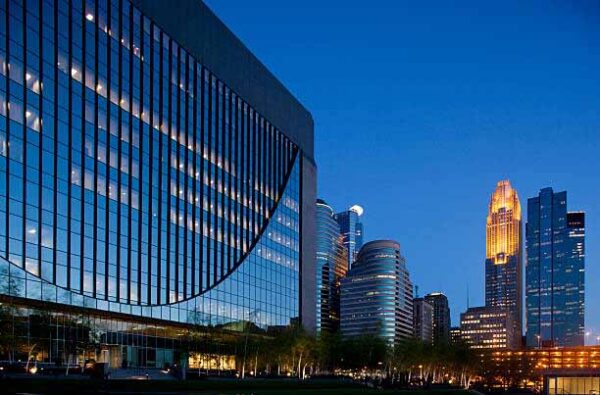
The new Minneapolis Fed building at 250 Marquette Ave. was a marked change from the buildings previously occupied by the bank. Michigan architect Gunnar Birkerts designed the building, employing the same principles that allow a suspension bridge to stand. The building opened in 1973 as the world’s first suspension building. Two-thirds of the bank’s total space was located underground, and nearly the entire block at the north end of Nicollet Mall was preserved as an open plaza. The building has since been remodeled, but the catenary arch that suspended the original building is still visible.
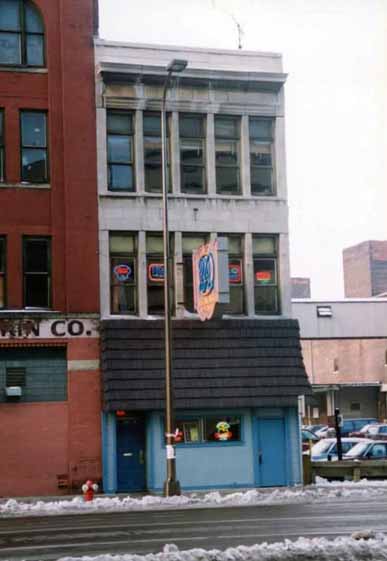
Yet again, the Minneapolis Fed outgrew its home. Settling on a site on Hennepin Avenue at the north end of downtown, the Fed engaged St. Louis architect Gyo Obata of Hellmuth, Obata & Kassabaum to design a campus that would complement the adjacent historic warehouse district and the Mississippi riverfront. The current home of the Minneapolis Fed opened in 1997 with an eight-story office tower at the corner of Hennepin Ave. and First St. North that connects via skyway and tunnel to the four-story operations center. The site was previously occupied by Native Americans who had a summer camp along the river, the Pacific Lumber Mills, the Great Northern Train Depot, which was demolished in 1978, and the Northup King seed company.