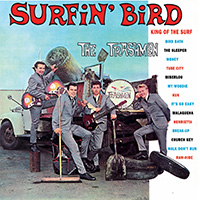

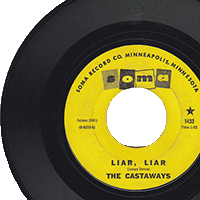
Sound 80
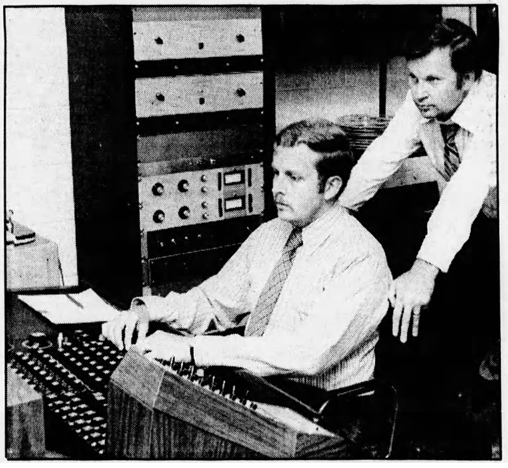
HERB PILHOFER AND TOM JUNG
For six years, composer/musician Herb Pilhofer worked at Kay Bank, later Universal Audio Recording Studio, and did most of his composing there. But he wanted to be able to be able to experiment with sounds and combine them in new ways. When he and three others who worked at the studio – Tom Jung, Gary Erickson, and Scott Rivard, expressed their frustration at the studio’s refusal to upgrade the studio to their standards, Pilhofer approached them with the idea of starting their own studio. They were each able to raise $5,000 of their own money, and they first set up in the living room and dining room of Pilhofer’s home near Lake Calhoun. (Minnesota in the ‘70s, Dave Kenney and Thomas Saylor, 2013)
The new recording studio was named Sound 80 by Pilhofer’s friend Brad Morrison, the same ad man who had previously christened the Hormel Ham Cure 81 (perhaps while sipping Vat 69 scotch). (Tom Hebers, City Pages, June 8, 2005)
4444 W. 76th STREET, EDINA
Sound 80 was initially located on the campus of a business called “Empire Photosound,” at 4444 W. 76th Street in Edina. Empire Photosound was a filmmaking company that Sound 80 worked with from time to time.
Pilhofer and Jung acquired a bank loan backed by the SBA, and negotiated a deal with the City of Minneapolis for the lot for practically nothing. They brought in a New York-based acoustical engineer to oversee the design and construction of their new “audio playpen.” (Kenney and Saylor)

Pilhofer said that the studio would be founded on “revolutionary new techniques,” and “It’s hard for most people to believe, but with modern recording techniques, and talented people who understand them you can create first rate sound almost anywhere. You could probably create Beethoven’s Ninth Symphony in a telephone booth if it was necessary. (Minneapolis Tribune, March 1, 1969)

An open house was held on May 29, 1969. The photo below shows the Moog Synthesizer, which takes up an entire wall (on right).
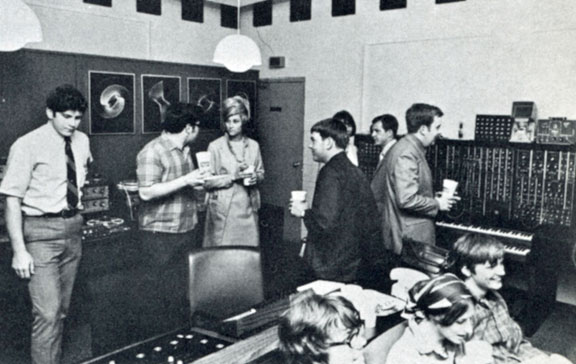
Herb owned the first Moog Synthesizer and Synclavier in the Midwest, which put him on the map as a musical technological wizard.

2709 EAST 25th STREET, MINNEAPOLIS
1970

In the summer of 1970, Sound 80 began to build a new studio.
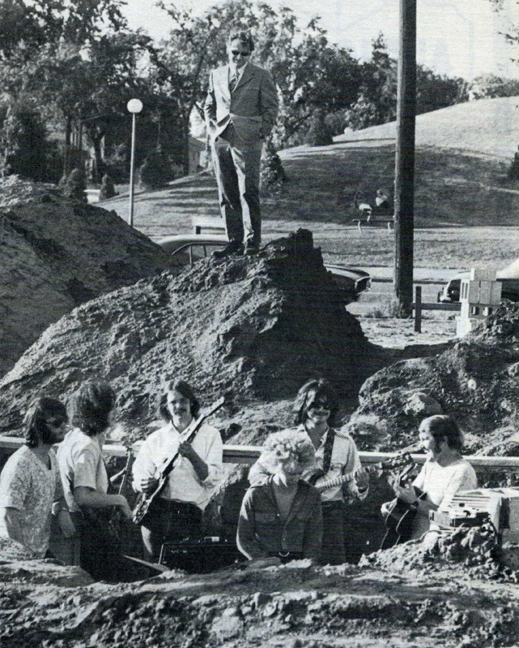
Mike Barich, staff photographer for Connie’s Insider, was on hand to memorialize the first “recording session” at the new location. Dale Menten kindly provided the names. Dale wrote, “I guess you could say we were laying down foundation tracks, but please don’t.” I did!
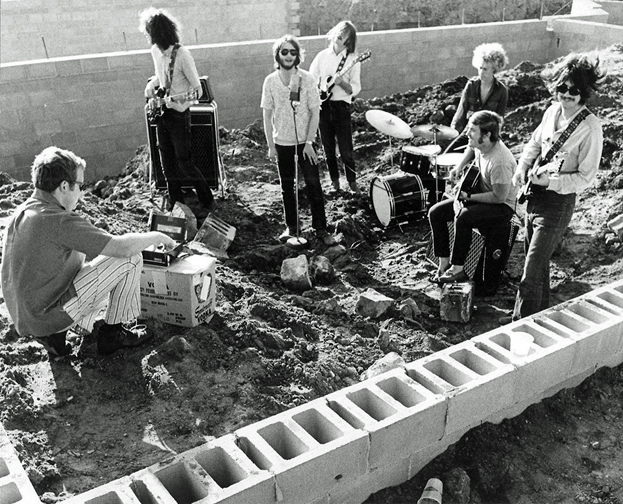
Here’s another photo from that day. Is that Herb on top of that pile of dirt?
1971
On March 9, 1971, the Minneapolis Star announced that Sound 80 had moved into its new building. It covered 12,000 square ft.

GLOWING REVIEW
Mike Steele reported, “It’s a technological dream, a rocker’s paradise, a fantasy world of flashing lights, twisting knobs, surrealistic sounds, and spinning discs … a monument to recorded sound and an investment in the future of the recording industry.” He further described,
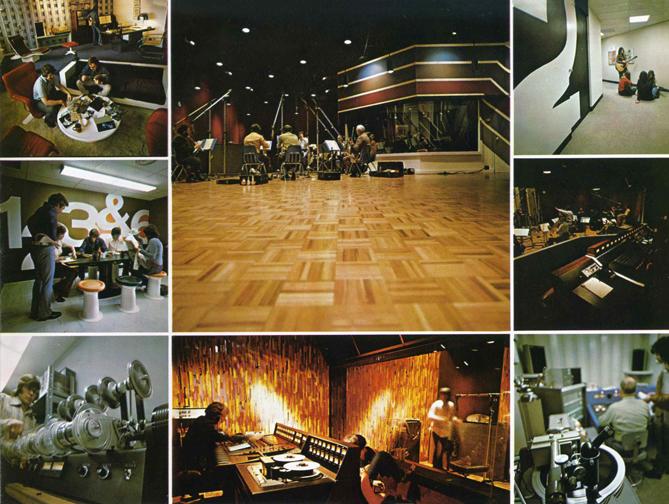
Each office is different, designed for the personality of the occupant. The studios have soft lighting – theatrical lighting for Studio Two along with primary-colored hassocks to create show-biz atmosphere for rock groups – and a casual, almost carefree environment. The harsh impersonality of the recording studio has been effectively wiped out.
But the equipment is here. Studio One has 8- and 16-track Scully recorders and sound alteration equipment and a console with 717 controls and 8 1/2 miles of wire. Rivard and his crew built the consoles themselves.
A third studio is small, built just for actors and announcers. Next to it is an innovation, a studio for recording and mixing tracks for films. This is a section that could become very big in the future with the introduction of video cassettes, possibly hooked to quadrasonic speakers.
There is an electronic music studio, a complete mastering laboratory for the production of masters or molds for pressing records, and a production shop for the development and design of sound systems. (Minneapolis Tribune, March 21, 1971)
TO THE PEOPLE
Herb brought his Moog out of the studio for a concert at the Lake Harriet Pavilion on July 17, 1971, warning that it would be one of the loudest ever staged there. The show included Dick Whitbeck’s Big Band and truckloads of amplification equipment.
It’s all an experiment. We won’t have the control of the sound that we do in a studio, of course. And the synthesizer isn’t a live performing instrument. It’s a piece of studio equipment, and you’re never quite sure what sound you’re going to get out of it. We’re not going to go for the bizarre, abstract electronic sounds, however, and we expect that everything we do will be quite musical. It’s all for fun. Dave Karr will be doing a few things , and my wife, Joanie, is going to sing. I enjoy performing for audiences, and I miss it. We’ve been so involved with the studio, with commercial things, that we haven’t done much for live audiences lately. But I think the neighbors ought to be warned. It isn’t exactly going to be Handel’s Water Music.
Their full-page advertisement in Billboard magazine on November 6, 1971, stated, “Minneapolis is 1.2 miles from one of the country’s seven great recording studios.”

1972
In late 1972, Sound 80 added a satellite studio on the 40th floor of the new IDS tower in Downtown Minneapolis. Bob Schultz, former president of Micside Studio, was the first head of that location. This site was intended to be used by advertising agencies and industrial users. (Minneapolis Tribune, November 19, 1972) Singer Arne Fogel attests that it was very small and used for voice work only, no music.
1973
In April 1973, the Insider included an ad that described the facility’s studios:
- Studio 1, the largest of five, is uniquely designed to allow musician, engineer and producer to maintain eye contact throughout the session. Three acoustically sealed panes of glass surround the control room to create a “together” feeling. And our 32-track interlock recording system, developed by Sound 80’s team of expert design engineers, really gets it all together.
- Studio 2, with 16-track capability, was specially designed for smaller groups (accommodating up to twelve musicians) and is decorated and lighted to create a feeling of closeness and intimacy between the performers.
- Studio 5. In the Neumann stereo MASTERING studio, tape-to-tape transfers are handled through a specially designed console.
1974
In the March-April, 1974, issue of the Insider, Sound 80 placed an ad listing the new equipment it had added to its studio:
- Two new recording consoles
- New multi-track recorders
- 20 channels of Dolby
- SX-74 cutterhead
- “Time line” digital time delay
- New Sound 80 Biamplified Monitor Systems
- New 9′ Steinway concert grand piano
It was here in December 1974 that Bob Dylan re-recorded half of his album “Blood on the Tracks” with a group of young Minneapolis musicians. Paul Martinson was the engineer on those sessions. See the link for the details of that story.
1975
Herb began working in collaboration with 3M in 1975, who had just invented multi-track digital recording.
1977
In early 1977, an unknown, teenage Prince Rogers Nelson came to Sound 80 to record a demo tape with the hope of landing a contract with a major label. His manager, Owen Husney, had arranged to have David Rivkin engineer the tape. Husney and Rivkin were old friends and bandmates from St. Louis Park. Prince played and sang all the parts himself; five tracks over two weeks. He took the tape to Los Angeles, and within a few weeks he had a six-figure contract to record three albums with Warner Bros. (Kenney and Saylor)
1978
In the spring of 1978, 3M brought a prototype digital tape machine into Sound 80 (nicknamed “Herbie” after Pilhofer). The size of a small refrigerator, the recorder converted music into a series of zeros and ones before being physically transferred to tape or disc. Head engineer Tom Jung recorded what are believed to be the first commercially released digital recordings: a jazz album with Flim and the BB’s, and two classical albums, both with the St. Paul Chamber Orchestra. Through this collaboration, Sound 80 became the World’s First Digital Recording Studio, certified by Guiness.

In the late spring of 1978, the Orchestra spent two days recording an album which featured Aaron Copeland’s “Appalachian Spring” and Charles Ives’s “Three Places in New England. In 1980, the album won a Grammy Award for best chamber music performance, making it the first commercial digital recording to earn such an honor. No one at Sound 80 knew that the album had been nominated, so the announcement came as a total shock when the staff read about it in the newspapers. (Kenney and Saylor)

1979
Jung resigned from Sound 80 in 1979, moved to Connecticut, and started an audiophile label, Digital Music Products.
In late 1979, 29-year-old Steven Greenberg came to Sound 80 to record an album with a group of studio musicians he called Lipps Inc. David Rivkin was at the console, Greenberg played most of the instruments, Cynthia Johnson provided the vocals, and they tested it out at St. Paul’s Oz nightclub. The song hit Number 1 nationally on May 31, 1980. (Kenney And Saylor) It was at the tail end of the Disco era, but is still used today, and has made Mr. Greenberg a rich man. Marsh Edelstein tells the story often that he was offered half of the song but turned it down. Oh dear.
1981
Sound 80 stopped recording in 1981.
ORFIELD LABS
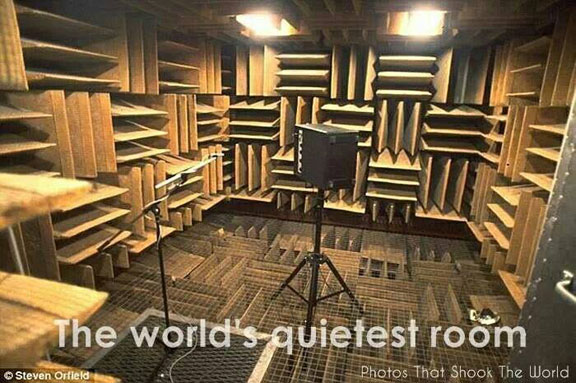
In 1990 the Sound 80 studio building became the headquarters of Orfield Laboratories, whose anechoic chamber, is labeled the “Quietest Place on Earth,” (measured at −9.4 dBA). It was deemed as such by the Guinness Book of World Records in 2005, but in 2015, it rescinded the honor in favor of a chamber at the Microsoft headquarters in Redmond, Washington. Orfield disputed the claim, saying Microsoft was held to different standards for its sound measurements, and Orfield Labs got the title back in late 2021.
In 2023, a New York Times Magazine reporter was determined to win the record for the amount of time sitting in the dark in the room, which had been previously set at two hours, so she reserved the chamber for three hours. She lasted the three hours. (Laura Yuen, Minneapolis Star Tribune, March 10, 2024)
Orfield labs achieved the designation for their friends at Sound 80 as “the world’s first digital recording studio” in the 2006 Guinness Book of World Records.
The two main studios are still fully intact, and they are filed for historic designation by the State and the Federal Government.

Sound 80 – the business – still exists in another space.