
Dove Studio
Dove Studio had two different locations in the Twin Cities.
1964
6217 LAKE STREET, ST. LOUIS PARK
In the Spring of 1964, Dove Recording Studio was opened by Don Peterson and Darold “Arv” Arvidson. This was primarily a recording studio, although two LPs and four singles were issued on the Dove record label. The owners bought their first studio from David Hersk, at 6217 Lake Street in St. Louis Park. Don ran the business side and Arv handled the technical side, building much of the equipment himself. The Novas recorded “The Crusher” there. Another band that recorded there was the Surfers (although Robb Henry of the Surfers remembers recording in a small house south of Minnetonka Blvd. between Texas and Louisiana in 1966-67.) The 6217 address does not at all compute, and houses in that area have been there for a long time. Could that be right?
1965
9358 JAMES AVE. S, BLOOMINGTON
The facility proved to be too small, and in early 1965 it was moved to 9358 James Ave. So. in Bloomington. This address doesn’t compute in the county’s property tax database. Former denizen and musician friend Arne Fogel says that the address has been changed to 1700 W. 94th Street, Bloomington, but this address still does not compute, even when checked with a real person at the tax office. The kind people at Bradley Products, who occupy the space in 2025, say it’s on the NW corner of 94th and James. This tells us that the County considers the address to be 9340 James Ave. So, Unit 3, built in 1962.


DOVE’S MIXING BOARD
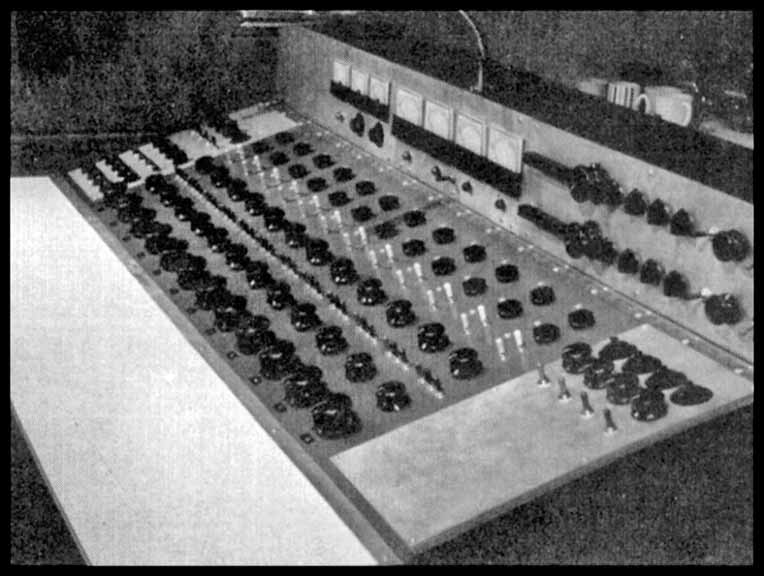
From Rod Eaton:
This was the mixing board at Dove studios. “Arv” Arvidson built the entire thing. It was almost six feet wide. There were twelve inputs. Originally it had just two outputs. When the studio bought its four-track recorder, the board needed to be modified. Arv did that in an unusual way. There was a switch – I think it’s the one centered below the four large VU meters – that “split the board.” Half of the inputs could be assigned to outputs 1 and 2, the other half to 3 and 4. That was just one of the board’s unique features. From bottom to top, each input section had the big “pot” to adjust level, a smaller pot for echo send, output assignment selectors, echo return, don’t remember what the next group of three switches did, then a rotary switch for low and high frequency EQ. The panel at far left contained the tape machine transport and record controls. The panel on the right was a sub-mix section for playback. I sat behind this monster for hours, but I’ve totally forgotten what the other things on the board did. Maybe Steve Longman will tell us – he engineered lots of sessions. The mixing board definitely had a homemade look but it was actually very sophisticated for the time. It was just one of the things that made Dove Studios an interesting place to record.

DOVE’S STUDIO A
Again from Rod Eaton:
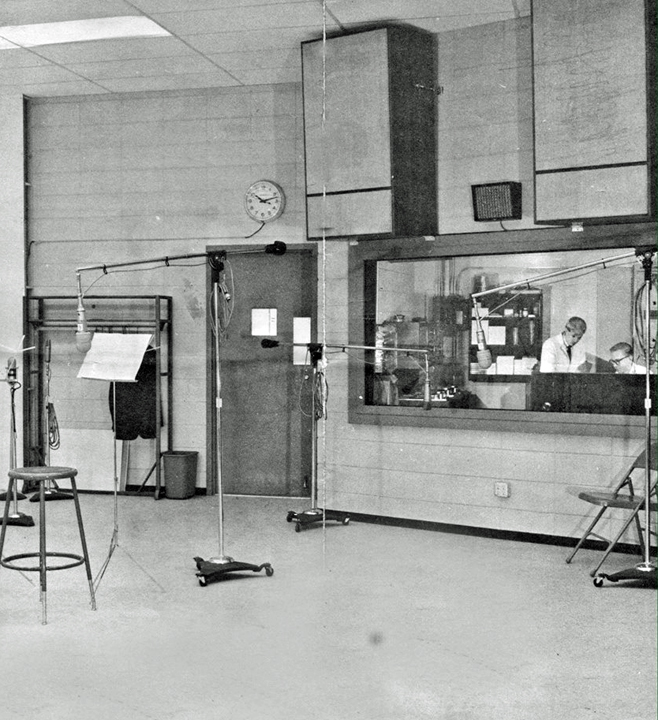
Here’s a photo of Dove Recording Studios’ Studio A. There was no B, C, or D – just A. The photo is from the Dove Rate Card, October 1, 1965. I don’t recall there being another version. The photo doesn’t really give a sense of the size of the room. It was pretty large – maybe 30 by 40 feet. The cement block walls would have been much too “live” by themselves, but the acoustical tile ceiling absorbed some of the bounce. In three of the corners floor-to-ceiling sound-deadening panels also improved the room’s character. I remember the studio having a bright presence and quick decay.
Over the control room window hung two ginormous Voice of the Theatre speakers. The smaller speaker in between was for talkback. It may also have doubled as the “car audio” speaker. Sometimes it was a good idea to hear a track the way it might sound on less-than-perfect speakers. The studio had a Steinway Grand and a Lowrey organ with a Leslie speaker. This photo was taken before the big wooden box housing the EMT Plate Reverb system was installed. It later sat where the coat rack is in this photo. Also a few years later a more-or-less isolated drum booth was built in one corner. Finally, if you look through the window into the control room, you can see the four-track Ampex recorder to the left. And that’s me in a white sweater standing behind the mixing board.
1966
Candy Floss Productions began in about 1966 and was owned by Dale Menten and Peter Steinberg. Steinberg was also a major stockholder in Dove Studios.
1967
The Litter recorded its 1967 album Distortions at the studio.
The Calico Wall’s drug-referencing ’67 single, Flight Reaction pushed the limits of sanity and sound technology, but they never got to play live, since bandleader Peter Steinberg was drafted shortly after the recording was made.
“Twenty Years Ago in Speedy’s Kitchen” was a local hit for T.C. Atlantic, recorded at Dove in 1967. It was written by Barry Thomas Goldberg, Dale Menten, Gary Paulak, and Peter Steinberg.


1968
C.A. Quintet recorded its dauntingly titled double album, “Trip Through Hell” was recorded in 1968, but may not have been released until 1969, remembers Arne Fogel.
Peter Steinberg and Dale Menten managed 17 local groups, and Steinberg won six of the seven Connie Awards he was nominated for in 1968.

Steinberg wore a black satin shirt with gold brocade, striped trousers, and a red satin cape. Commenting on his Superman outfit, he said later, “I dress like this all the time, but they only let me out once a week.” (Minneapolis Tribune, May 28, 1968)
“To look like a national group, you’ve got to dress like one,” Steinberg said. And originality is the one thing that sets you apart.” (Minneapolis Star, May 28, 1968)
Michael Yonkers’s “Microminiature Love” was recorded at Dove in 1968, but wasn’t released until 2001.
1969
Candy Floss Records went out of business.
The Stillroven and the Underbeats also recorded at Dove.
Original copies of “Trip Through Hell,” “Distortions,” and other Dove creations are rare and fetch high prices among record collectors/speculators.
1970
Dove closed its doors in early 1970, selling the equipment to Warren Kendrick, who started Audio City studio on East Lake Street.
1998
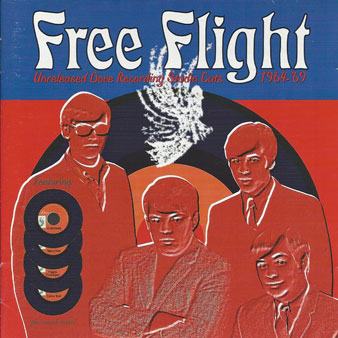
A compilation of unreleased Dove recordings called Free Flight was issued by Get Hip Records in 1998.